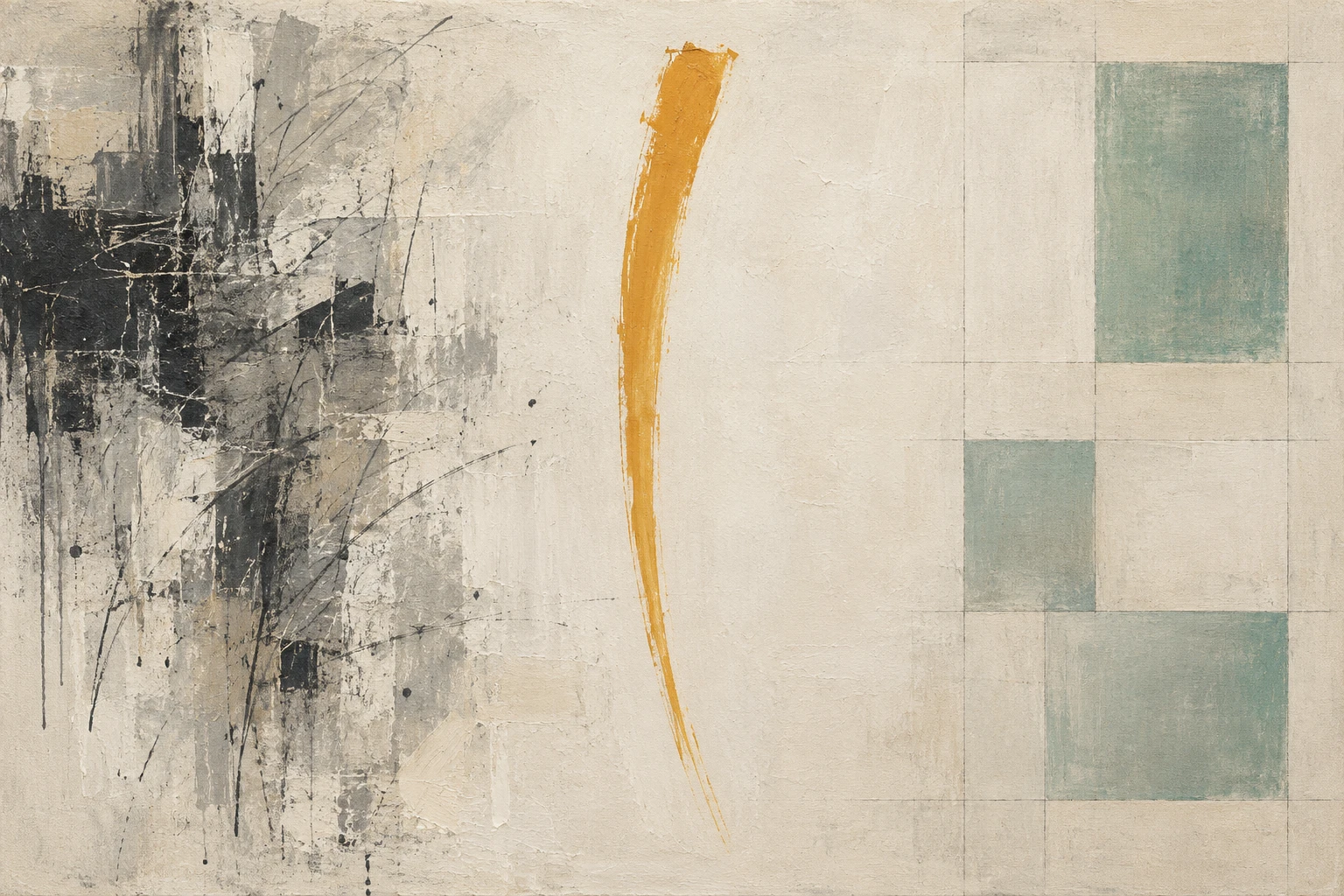
I asked an AI to read about 2,000 of my messages and describe my taste.
Then I asked another AI to paint it.
Restless Marks, Quiet Order. The image model chose the title.
What the AI read
It read 2,154 messages across 133 sessions. These are work chats with an AI
agent, not diary entries. Everything below comes from what I actually typed.
Taste
In my own words
What it means
Minimal
“One screen shows everything.” “Simpler is better.”
Subtract first.
Aligned
“These two columns are not aligned. It looks ugly.”
Spacing, color and theme must be consistent.
Overview first
“Too long. Make this the detail page and give me a short overview.”
One screen, details one click away.
Short answers
“One-line root cause. One-line fix.”
Tables and single sentences.
Evidence
“Show me good and bad examples side by side.”
I decide by looking, not by reading.
Quick to cut
“This one is not good enough. Remove it.”
Defend nothing that does not work.
First principles
“Why are there two modules?”
Ask for the simplest design before the clever one.
Direction is mine
“Do not commit yet.”
I decide the key calls.
Execution is theirs
“Fix your own mistakes. I will check in the morning.”
Work that can be verified should not wait for me.
How to read it
Left. The noise of real work: logs, requirements, servers, half-formed
ideas.
Right. A quiet, aligned grid. One screen, readable at a glance.
Middle. One amber stroke. It is the only saturated mark on the canvas,
and it is the decision.
The title says where the painting goes, from restless marks to quiet order. It
does not say who gets it there. That is the amber stroke, and it is the part I
care about most.
Apparently I would rather spend my effort deciding what to remove than adding
more.
The prompt behind the painting
An abstract painting, no figures, no objects, no text, no symbols, no diagrams.Landscape 3:2, museum-quality fine art, shot straight-on as a gallery photographof a large canvas.CONCEPTThe quiet moment when noise resolves into order. A restless, layered field onthe left slowly calms, passes through one decisive gesture, and settles into astill, precisely ordered field on the right. The painting is about restraint:what has been removed matters more than what remains.MEDIUM AND SURFACEOil and cold wax on linen. Visible canvas weave, thin translucent glazes, subtlescraping and squeegee marks, soft matte finish. The left side is gestural andlayered; the right side is flat, even and almost silent. Handmade, neverdigital-looking.COMPOSITION- Roughly 60% of the canvas is calm empty space in warm off-white and pale bone.- Left third: dense, overlapping charcoal and warm-gray strokes, scumbled and scratched, crossing at different angles, with a few small flecks and drips.- Center: one single, slightly curved, confident vertical line in warm amber (#E8A33D), drawn in one breath, slightly thicker at the top and tapering down. It is the only saturated mark on the canvas. Generous empty space around it.- Right third: very faint, perfectly even horizontal and vertical hairlines forming a barely visible grid, with a few soft rectangular planes of muted teal aligned to that grid. Crisp edges, exact spacing.- The transition from left to right is gradual: strokes thin out, straighten, then disappear into the grid.PALETTE (strictly limited)warm off-white (#F4F1EA), bone (#E6E1D6), charcoal (#2B2B2A), warm gray(#8E8B83), one amber accent (#E8A33D), one muted teal. Nothing else.AVOIDFigurative elements, arrows, funnels, icons, letters, numbers, UI elements,flowchart look, robots, brains, light bulbs, neon, glitter, rainbow palettes,heavy shadows, 3D rendering, glossy gradients, clutter, frames or mockup rooms.
Where the AI may be wrong
It only saw work. Nothing about how I am with people, or how I lead.
Repetition inflates. The same sentence appears in several forked
sessions, so some themes are louder than they are.
It did not see what I approved. I mostly speak up when something is
wrong, so my taste reads as a list of complaints.
“Minimal” is too simple. I also ask for long, detailed reports when I
need to print them. The real rule is short where it can be, detailed where it
must be.